Mostrando entradas con la etiqueta Nyctalus. Mostrar todas las entradas

martes, 5 de marzo de 2019

Manual de conservación y seguimiento de los quirópteros forestales

Ayer me llegó mi ejemplar del "Manual de conservación y seguimiento de los quirópteros forestales", que fue presentado en las Jornadas SECEMU de Gibraltar del pasado diciembre:


Yo participo con un par de fotos del trabajo con Nyctalus lasiopterus en el Parque Natural Los Alcornocales (Cádiz): 

Cita recomendada: Guixé, D. y Camprodon, J. 2018. Manual de conservación y seguimiento de los quirópteros forestales. Ministerio de Agricultura, Pesca y Alimentación, Ministerio para la Transición Ecológica. Madrid.

Se recoge, entre otras cosas, un capítulo a modo de guía clásica de murciélagos con 10 especies vinculadas a los bosques. A destacar el mapa de distribución con datos que entiendo que son actuales y consensuados (por ejemplo aparece Pipistrellus nathusii en Menorca, que es un dato confirmado aunque aún no hay -que yo sepa- un artículo científico describiendo esa cita).

Otro capítulo especialmente interesante para nosotros en este momento por los trabajos que estamos haciendo en Menorca es el cajas-refugio, escrito por Juan Tomás Alcalde

Está accesible en PDF en esta dirección:

martes, 20 de febrero de 2018

XXII Congreso SEIMC-2018: Vigilancia de diferentes especies de virus y bacterias en argásidos asociados a murciélagos en España

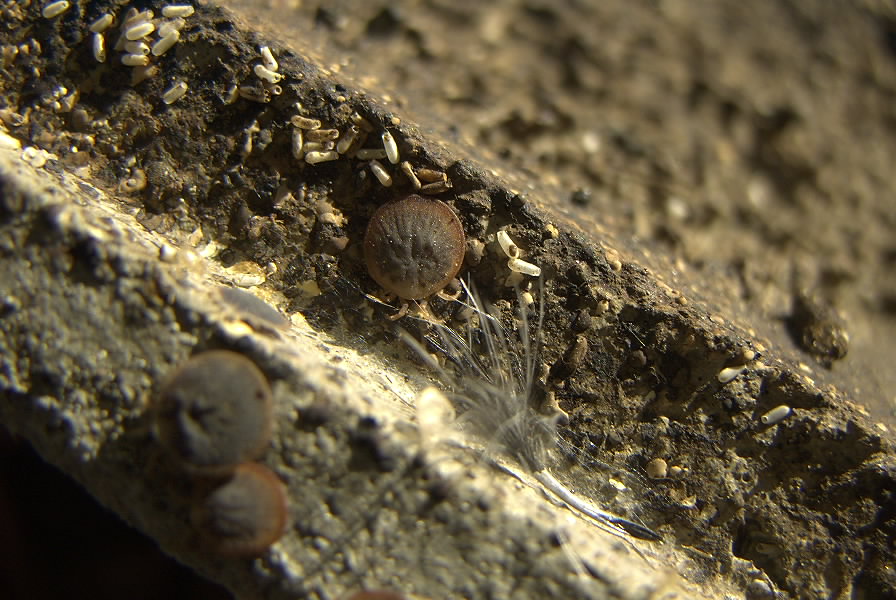
Argas vespertilionis junto a huevos de cimícidos en una caja-refugio de fibrocemento Schwegen en Doñana. Foto: Ana G. Popa-Lisseanu.
Con el mismo título que éste post llevamos una comunicación al XXII Congreso Nacional de la Sociedad Española de Enfermedades Infecciones y Microbiología Clínica (SEIMC) que tendrá lugar del 24 al 26 de mayo de 2018 en Bilbao.

Los compañeros del Centro de Rickettsiosis y Enfermedades Transmitidas por Artrópodos Vectores, de Logroño, han buscado filo y flavivirus así como rickettsiales y espiroquetales en las muestras de las garrapatas blandas Argas vespertilonis que viven en las cajas refugio del nóctulo gigante (Nyctalus lasiopterus) en Doñana, con las que estamos trabajando Carlos Ibáñez y yo mismo, del Grupo de Murciélagos de la Estación Biológica de Doñana

Autores: Paula Santibáñez 1, Arantza Portillo 1, Carlos Ibáñez 2, Ana M. Palomar 1, Juan Quetglas 2, José Antonio Oteo 1.

1Centro de Rickettsiosis y Enfermedades Transmitidas por Artrópodos Vectores, Departamento de Enfermedades Infecciosas. Hospital Universitario San Pedro-CIBIR, Logroño, España.

2Estación Biológica de Doñana (CSIC), Sevilla, España.

Tras el congreso publicaremos otro post con el resumen y el póster.

Captura de argásidos y cimícidos en una caja-refugio de murciélagos en Doñana. Foto: Sonia Sánchez-Navarro.

miércoles, 9 de agosto de 2017

Ya ha terminado el XIV Congreso Europeo de Murciélagos

Ha finalizado el 14th European Bat Resarych Symposium, EBRS2017

El libro de resúmenes se puede descargar aquí.

Desde Murcielagosymas no hemos podido asistir pero hemos recopilado algunos resúmenes que nos han llamado la atención o que son más afines a las nuestras líneas actuales de trabajo. Hay muchos más, todos muy interesantes.
[O]= Presentación Oral
[P]= Poster


IMPORTANCE OF HOST ECOLOGY FOR THE PRESENCE OF BARTONELLA SPP. IN THE ECTOPARASITES OF INSECTIVOROUS BATS IN CENTRAL AND SE EUROPE [O]

ATTILA D. SÁNDOR, ALEXANDRA CORDUNEANU , LEVENTE BARTI , PÉTER ESTÓK , TAMÁS GÖRFÖL, MIHÁLY FÖLDVÁRI , HEIN SPRONG , ZOLTÁN LÁSZLÓ , GÁBOR FÖLDVÁRI ,

Bats are ideal hosts for a number of specialised arthropod ectoparasites, such as mites, ticks, fleas and flies. Their most specialised ectoparasites are the hippoboscoid flies, mostly flightless flies occurring only on bats. Throughout their blood-feeding, these ectoparasites are able to transmit a number of pathogens, and are known vectors of a number of viral, bacterial or protozoan diseases. Among these, a wide variety of bacteria of Bartonella spp. are known to parasitize bats and their ectoparasites. The aim of the present work was to assess, by PCR and sequencing, the prevalence and diversity of Bartonella spp. in hippoboscoid flies of bats occurring naturally in Hungary and Romania, and to find factors contributing to the high diversity recorded. In order to achieve this, we made molecular identification of Bartonella sequences from parasitic flies and compared them to sequences deposited in GenBankTM and evaluated the importance of host and vector ecology for the presence and prevalence of these bacteria. In our study 158 bat flies tested positive for Bartonella spp. DNA (29.1%). Bartonella spp. sequences were identified in 8 out of 10 Nycteribiidae fly species, collected from 11 out of the 14 bat species studied. Polyxenous bat flies had the lowest prevalence. Individual nycteribiid fly species explained the distribution of Bartonella spp. only marginally; with only 4 species contributing significantly to the observed pattern. Bat host species explained most of the variance found in Bartonella spp. distribution, with 6 individual species significantly contributing to the modelled distribution. Bat gender was another significant factor, with males carrying more than twice as many Bartonella-positive bat flies than females. The bat roost site also made an important contribution, as significantly higher number of Bartonella-infected bat flies were collected on bats using underground shelters, than from bats roosting either in buildings or in trees.


NEW DATA ON THE PRESENCE OF NATHUSIUS’S PIPISTRELLE IN THE CANTABRIAN COAST: A MIGRANT OR RESIDENT SPECIES?[P]

 JUAN T. ALCALDE1 **, MIKEL ETXANIZ2 , ESTELA RUIZ DE AZÚA2 , NEREA AZPEITIA2 , ALBERTO LUENGO2 , IÑAKI MARTÍNEZ1 , **jtalcalde@gmail.com 1Spanish Association for the Study and Conservation of Bats, SECEMU, Spain; 2Ekoetxea Txingudi - Plaiaundiko Parke Ekologikoa. Irun, Gipuzkoa, Spain.

Nathusius’s pipistrelle is a long distance migrant species, although sedentary populations are also known. In the Iberian Peninsula it is a very rare species: most of the data come from isolated individuals found in autumn or winter and are attributed to migrant specimens, but so far, their movement patterns are unknown. However, on the Mediterranean coast (NE of the Iberian Peninsula) there is a small resident population, which in summer only hosts males. In the last two years observations of this species have been collected in two bat boxes located in the Bay of Txingudi (Cantabrian coast). Both males and females have been identified, and their presence has been verified for 8 consecutive months, from the end of August to the beginning of May. Only in the warmer months does it seem to be absent from the site.


IDENTIFICATION OF RHINOLOPHID BAT NURSERY ROOSTS FROM RECORDINGS OF ADULT ULTRASOUND SOCIAL CALLS AND ULTRASOUND DEVELOPMENT CALLS MADE BY INFANTS[O]

MARGARET M. ANDREWS1 **, AMELIA M. HODNETT2 , PETER T. ANDREWS3 , **mmandrews37@gmail.com 1 Liverpool John Moores University, Liverpool L3 3 AF, U.K.; 2Gavia Environment, Perth, PH 1 3FX, U.K.; 3Department of Physics, University of Liverpool, Liverpool L69 3 BX, U.K.; deceased.

Ultrasound calls of infant greater horseshoe bats (Rhinolophus ferrumequinum) and lesser horseshoe bats (Rhinolophus hipposideros) were recorded from birth to 27 days of age in two separate roosts in Wales in June and July using a time expansion bat detector modified for 24 hour recording periods. The ultrasound social calls of adult greater and lesser horseshoe bats were also recorded in the two nursery roosts and were classified according to the frequency of the fundamental, the number and duration of the harmonics and the number of syllables in a phrase. The constant frequency (CF) or frequency modulated (FM) calls were compared with adult social calls identified previously. Although the echolocation frequencies of the greater horseshoe bats were typically 83-84 kHz and the lesser horseshoe bats 110-114 kHz the infant calls were similar. Ultrasound calls with fundamental frequencies between 15-42 kHz were identified as 7 categories of infant development calls and 15 categories of adult ultrasound calls. There were five distinct stages in the development of infant ultrasound calls recorded with the age of the infant bats, determined by forearm length. Stages 1-3 developed from polyharmonic isolation calls uttered through the mouth to attempts at echolocation and corresponded with Type A-C adult ultrasound social calls. Stages 4-5 infant calls were nasal attempts at echolocation that corresponded with Type E adult modified echolocation calls. There were no comparable infant calls to the Type D adult advertisement calls. A survey of ten lesser horseshoe roosts in Wales showed that infant ultrasound calls provide a means of identifying not only the presence of a nursery roost but the dates at which births started and infants began flying, The ideal time for static preset extended periods of monitoring would be from 20.00 - 08.00 h GMT in June and July. This ultrasound monitoring provides a simple non-invasive method of identifying nursery roosts.


TREATMENT OF SOME BACTERIAL INFECTIONS IN FIVE EUROPEAN BAT SPECIES[P*]

 ANNA BATOR1 **, BARBARA GÓRECKA2 , KATARZYNA PTAK3 , KATARZYNA SIEDLECKA-KOWALCZEWSKA4 , KATARZYNA SULIMA, **mystacinaa@gmail.com 1Department of Zoology, Faculty of Biological Sciences, University of Zielona Góra, Szafrana 1, 65-516 Zielona Góra, Poland; 2BAT MOM Barbara Górecka, Poland; 3Animal Care Vet Clinic in Klodzko, Poland; 4Andi Vet Clinic in Kielce, Poland.

We describe bacterial infections first diagnosed in two European bat species (common noctule bat, Nyctalus noctula – two specimens; and greater mouse-eared bat, Myotis myotis – one specimen). All animals had the same unspecific symptoms: weight loss, skin redness, skin pigmentation loss, baldness, swollen joints, weakening of the skin structure, necrosis of distal parts of tail and phalanges. All bats were diagnosed using antimicrobial susceptibility testing of swab samples. Three different antibiotics were prescribed for three different bacteria: Pseudomonas aeruginosa – marbofloxacin (two common noctule bats and one greater mouse-eared bat), Staphylococcus intermedius – enrofloxacin (one common noctule bat). Treatment was long and exhausting. Bats suffered from weakness and spot skin necrosis (marbofloksacin). We used convalescence support instant diet for cats and dogs, betaglucane, Duphalyte and probiotics. The same treatment was successfully applied to other bats with the same symptoms but without laboratory diagnostics (nine common noctule bats, five parti-coloured bats (Vespertilio murinus), three serotine bats (Eptesicus serotinus) and one Nathusius's pipistrelle (Pipistrellus nathusii). Bats during rehabilitation or living in captivity suffer from immunodeficiency, probably caused by previous malnutrition, mono diet, lack of milk antibodies (infants), stress or a combination of these. There is a clear need to include the laboratory diagnostics in the treatment and rehabilitation of bats.


COMPARATIVE PHYLOGEOGRAPHY OF TWO CRYPTIC SEROTINE BATS IN THE IBERIAN PENINSULA AND GENE FLOW CONSEQUENCES OF BEING TOO SIMILAR [O]

 ALEJANDRO CENTENO-CUADROS1 , ORLY RAZGOUR2 , CARLOS IBÁÑEZ1 , OSCAR DE PAZ3 , GONZÁLO PÉREZ-SUÁREZ3 , SUSANA MARTÍNEZ-ALÓS3 , JUAN L GARCÍA-MUDARRA1 , ADRIÁN REDOND1 , JAVIER JUSTE1,4**, **juste@ebd.csic.es 1Estación Biológica de Doñana (CSIC), Seville, Spain; 2Biological Sciences, University of Southampton, Southampton, U.K.; 3Depto. Ciencias de la Vida, Universidad de Alcalá, Madrid, Spain; 4CIBER of Epidemiology and Public Health (CIBERESP), Madrid, Spain. We investigated the genetic diversity and structure within two sibling serotine bats (Eptesicus serotinus and E. isabellinus) in Iberia, both in their contact zone and in allopatric areas of their respective distributions and combining the information of a fast evolving mtDNA Hyper Variable (HVII) fragment and 10 microsatellites. A multimarker approach combining the information of the microsatellites with mtDNA sequences through Approximate Bayesian Computation (ABC) was used to test different phylogeographic patterns, and clustering algorithms based on codominant markers were used to identify possible gene flow and the presence of hybrids between the two species. Sampling included a total of 107 E. serotinus bats from 6 maternity colonies (two of them located in the contact zone between the two species), and 231 E. isabellinus from 13 maternity colonies (five within the area of sympatry). mtDNA diversity was slightly higher and showed deeper geographic structure for E. isabellinus. Haplotypes relationships showed no mitochondrial introgression or capture between the two species. Microsatellites showed two main groupings corresponding to the two species with similar diversity values between them and null within species structure, as expected in a male mediated gene flow system. ABC inference placed both species’ populations split times as post-LGM and in continuous expansion. The central sympatric populations were colonised from the allopatric populations at approximately 6250 years ago for E. isabellinus and 2600 years ago for E. serotinus. The combined model indicates that contact between the sympatric central populations has resulted in gene flow from E. isabellinus to E. serotinus. Specific assignment tests confirmed the existence of hybrids in both species and which were found only in the contact zone. Hybridization proved to be highly asymmetrical, and as predicted by the ABC, most of the cases were found within the two sympatric colonies of E. serotinus,


PURPOSE-BUILT HIBERNACULA FOR BATS – ARE THEY FUNCTIONAL? [P]

 ERIC A. JANSEN1 , VITA J.A. HOMMERSEN1 **, HERMAN J.G.A. LIMPENS 1 , MARCEL J. SCHILLEMANS1 , MAURICE LA HAYE1 , MARTIJN VAN OENE1 , **vita.hommersen@zoogdiervereniging.nl 1Dutch Mammal Society, Nijmegen, The Netherlands.

In many lowland areas bats are mostly restricted to artificial buildings and other underground structures for hibernation. An increasing economic pressure stimulates either the re-use of these structures or their demolition to make space for new developments. This results in bats loosing many of their (to us unknown) hibernation sites. To compensate for this loss of hibernation sites, the first purpose built hibernation structures were built in 1984. Between 1984 and1991, on average two structures intended as underground bat hibernacula, were built per year. Change in subsidy policies and the discovery of cheaper ways to build underground sites accelerated the construction of new hibernacula. Between 1991 and 2015, between 6 and 12 structures were built annually. These structures were mainly built as active conservation measures, often as a part of local landscape enhancements. We estimate at present 200 purpose-built bat hibernation structures exist in the Netherlands. However, the effectiveness of these purpose-built hibernation structures is often debated between conservationists. To gain insight in the effectiveness of these structures in the Netherlands, we analyzed the database containing all hibernation counts of the Dutch Mammal Society, which is managed within the framework of the Network Ecological Monitoring (NEM). Among all hibernation sites we focused on purpose-built structures. The structures used in our analysis varied from smaller square concrete profiles covered with earth (4– 20 m2 ) to larger and more complex structures (> 50 m2 ). We checked what proportion of these purpose-built structures is used by hibernating bats, calculated the time since construction and what proportion seems not to be used even after prolonged waiting times. We try to correlate these data with volume, type of surrounding landscape, distances to known traditional hibernacula, differences in regional densities of different bat species (in winter) and on-site climate condition


BEHAVIOURAL AND PHYSIOLOGICAL RESPONSES IN RHINOLOPHUS EURYALE IN HIBERNATION[O*]

 EDITA MAXINOVÁ1,2**, INAZIO GARIN2 , MARCEL UHRIN1 , **edita.maxinova@gmail.com 1Department of Zoology, Faculty of Science, Pavol Jozef Šafárik University in Košice, Košice, Slovakia; 2Department of Zoology and Animal Cell Biology, University of The Basque Country UPV/EHU, Leioa, The Basque Country.

 We studied behavioural and physiological features related to foraging during winter arousals from torpor in the Mediterranean horseshoe bat, Rhinolophus euryale. The observed colony hibernated in a cave located on the border between Slovakia and Hungary during four hibernation periods from autumn 2011 until spring 2015. We analyzed foraging, digestion, defaecation and microbial flora of bats by non-invasive methods from the faeces and based on morphological analysis, DNA analysis, proteonomic analysis, petrographic analysis, cytological analysis, microbiological cultivation and non-cultivation analyses and biochemical analyses of digestion enzymes. We found that R. euryale intermittently aroused during winter and produced both typical consumptive as well as non-consumptive faeces (produced after no feeding activity). This species became active and emerged from the cave mainly when the outside temperature was mild. Consumptive faeces during the winter contained only the order Lepidoptera. Non-consumptive faeces contained high concentration of inorganic material of cave origin and the virtual lack of prey indicates that drinking as well as direct sediment consumption occurred. Enterobacteria and enterococci in the faecal samples decreased during hibernation and only reached pre-hibernation numbers at the end of hibernation. There were time-dependent changes in the gut microflora and the decrease in bacterial variability was dependent on the hibernation stage. The activity of digestive enzymes (amylase, chitobiase, endochitinase, glucosaminidase) was detected in fresh feaces during the whole winter. Activity of chitinases was relatively stable during the winter, but activity of amylase was highest during late November and December. We conclude that R. euryale is physiologically ready to hunt during the winter when suitable conditions occur, but winter arousals are unlikely to be directed towards gaining energy through foraging, but more likely are aimed at active drinking.

lunes, 30 de enero de 2017

VI Jornadas SECEMU en Portugal, Diciembre 2016 (yIII)

Con esta tercera entrega concluimos los posts sobre las VI Jornadas SECEMU en Vairão (Portugal)

Bacalo en Vila do Conde. VI Jornadas SECEMU

Selfie en el Atlántico, Juan Quetglas y Daurín Rodríguez-Mena. VI Jornadas SECEMU

Los resúmenes se pueden descargar aquí.

El programa fue este

El facebook de las jornadas, aquí.

Se comentó que se colgarían los PDFs de los pósters. En cuanto lo tenga localizado lo incluyo aquí.

Todas las jornadas fueron muy interesantes. En estos posts (poster, comunicaciónes) hablamos de las que llevamos desde Andalucía, y aquí recogemos una selección del resto de comunicaciones:

Elena Tena nos presentó algo en lo que yo había pensado desde que era estudiante de la Universidad Autónoma de Madrid: Murciélagos de los parques de Madrid, llegando a encontrar siete especies en El Retiro, (Pipistrellus pipistrellus, P. pygmaeus, P. kuhlii, Tadarida teniotis, Eptesicus serotinus, Nyctalus leisleri, Hypsugo savii).
^ö^

Federica Roscioni del GIRC nos habló del proyecto de estudio de los murciélagos en el Lazio (centro de Italia, zona de Roma). Me llamó la atención el que la especie cavernícola con la mayor colonia era Myotis blythii, con con un censo de 6.625 ejemplares el 25/06/2014, seguida de otra de 6.271 Myotis blythii el 04/07/2014.
^ö^

Juan Tomás Alcalde, presidente de SECEMU, nos habló de su experiencia en la construcción de un refugio artificial para murciélagos cavernícolas en Navarra.
Se trataba de ofrecer un refugio a los murciélagos que ocupaban las instalaciones de una antigua piscifactoría que se iba a demoler por peligro de derrumbe.
Las construcciones habían sido ocupadas por cuatro agrupaciones reproductoras de murciélagos,formadas por alrededor de 35 Rhinolophus ferrumequinum, 80 Rhinolophus hipposideros, 90 Myotis emarginatus y un número indeterminado de Pipistrellus pipistrellus.

Consiguieron con éxito ofrecer un refugio que fue muy bien aceptado por los murciélagos. Consistía en dos casetas prefabricadas de hormigón, una general y otra aparte para Rhinolophus hipposideros.
En un primer momento hubo problemas de sobrecalentamiento que fueron corregidos pintando las casetas con pintura antitérmica y colocando un doble tejado.

En julio de 2016 llegó a haber 417 Myotis emarginatus, 93 Rhinolophus ferrumequinum y 44 Rhinolophus hipposideros, además de Pipistrellus refugiados bajo techado extra.

^ö^

Maria Joao Silva nos presentó el Centro Ciencia Vioa do Alviela. Aquí están los enlaces para que investigueis;
http://www.alviela.cienciaviva.pt/home/

Destacamos su quiroptario, con muchos aparatos para descubrir los murciélagos con nuestros cinco sentidos

Sus cámaras IR siguiendo las colonias de Alviela : [No funcionan en el momento de escribir este post, creo que las activarán en época de cría]. Vídeos grabados aquí.

Colonia de cría de Miniopterus schreibersii en Lapa da Canada. (cámaras activas a partir de principios de marzo, en el link hay grabaciones).

Terminamos las jornadas con un documental que no dejó indiferente a ninguno:

Teaser

Documental en El Escarabajo Verde


jueves, 26 de noviembre de 2015

Laboratorio de Nyctalus lasiopterus en Doñana

El trabajo principal al que nos estamos dedicando en este 2015 es la puesta en marcha de un laboratorio virtual para el estudio del nóctulo grande -también llamado nóctulo gigante-  (Nyctalus lasiopterus) en Doñana, dentro del Grupo de Ecología y Sistemática de Quirópteros de la Estación Biológica de Doñana (CSIC), con el proyecto "Adaptación y mejora de la Internacionalización de la e-infraestructura ICTS-RBD para la ESFRI-Lifewatch".


Hembra de nóctulo grande (Nyctalus lasiopterus), marcada con anilla y transponder para su seguimiento automático en la Reserva Biológida de Doñana. Foto Hector Garrido.


En el entorno del palacio de Doñana, en la Reserva Biológica de Doñana (RBD) hay instaladas una serie de cajas-refugio para murciélagos, que son utilizadas por los Nyctalus lasiopterus y Pipistrellus pygmaeus, el murciélago más grande y el más pequeño de Europa, respectivamente.


Los nóctulos de esta colonia están marcados con Micro Transponders Trovan ID-100A de 2.12x11.5 mm (como los microchips que se ponen a perros y gatos). Las cajas refugio utilizadas por los nóctulos (una docena de más de un centenar instaladas) están dotadas de una antena y un lector automático de RFID, (lector de transponders), que nos permite saber qué individuo y en que fecha y hora ha estado en cada caja. Estamos terminando los últimos retoques para que es información se pueda consultar online en tiempo real.


Las cajas están dotadas también de un sensor de temperatura interno que toma una medida cada 15 minutos, y que también se podrá acceder por internet.


Estas son las cajas refugio monitorizadas (fichero KMZ, de Google Earth). En amarillo las que tienen cámara y lector de transponder. En naranja las que sólo tienen lector de transponder.


Aquí puedes ver el mapa de la ubicación de las cajas refugio que ofrecen por internet  los registros de lectura de transponders y la temperatura, (de momento de acceso restringido, estamos trabajando en habilitar enlaces abiertos al público)


A unos 200 m de las cajas refugio hay una estación meteorológica de la AEMET, donde podemos ver la temperatura, humedad, precipitación y velocidad del viento. Pincha aquí para ver las últimas 24 h. En esta carpeta se pueden consultar las gráficas diarias entre el 08-Enero-2015 y el 29-Noviembre-2015.


Por último las cajas refugio son monitorizadas por cámaras de luz infrarroja que graban automáticamente los eventos de entrada y salida de las cajas.Con ellas podemos comprobar a qué corresponden las lecturas de los transponders (entrada, salida, permanencia en la puerta, o posado momentáneo en la puerta), si pasan cerca sin tocar la caja, si hay murciélagos que no estén marcados, y otras datos colaterales como el acoso de los cárabos (Strix aluco) sobre los murciélagos, la presión de los estorninos (Sturnus unicolor) por ocupar las cajas. Finalmente ofrecen la posibilidad de estudiar la el murciélago de Cabrera (Pipistrellus pygmaeus), cuando utilizan alguna de las cajas-refugio con monitorización para nóctulo.

Cárabo posado en la Caja 32, pendiente de los murciélagos.

Estornino en la boca de la caja 32B. En segundo plano se ve la caja 32.
Estornino en la caja 132.


Las grabaciones y las lecturas de transponders están sincronizadas con el servidor de hora de la Armada, (IP: 150.214.94.5)

Pincha sobre la caja que quieras ver en directo.


Caja 29

Caja 32B

Caja 32

Caja 132

Caja 104

Caja 105

Caja 107

Caja 130

Caja 93

Las grabaciones almacenadas, registros de temperatura y lecturas de transponder se podrán consultar en www.ebd.csic.es, pero estamos en obras.

Tomas falsas: Además de los murciélagos entrando y saliendo, también hay muchas otras cosas que pueden hacer saltar las grabaciones e inundar de gigas de grabación los discos duros. La niebla, la lluvia, otros mamíferos, insectos y, especialmente, las arañas, que cuando tejen su tela en la mísma cámara generan grabaciones durante toda la noche, son los principales.

sábado, 28 de febrero de 2015

Seasonal Variation in Stable Carbon and Nitrogen Isotope Values of Bats Reflect Environmental Baselines. Nuevo artículo nuestro en PLoS ONE 2015

Acaba de salir nuestro artículo:

Ana G. Popa-Lisseanu, A.G., S. Kramer-Schadt, J. Quetglas, A. Delgado-Huertas, D. H. Kelm, & C. Ibáñez. 2015. Seasonal Variation in Stable Carbon and Nitrogen Isotope Values of Bats Reflect Environmental Baselines. PLoS ONE 10(2):e0117052. doi:10.1371/journal.pone.0117052.

[La variación estacional en los valores de isótopos estables de Carbono y Nitrógeno de murciélagos reflejan los cambios ambientales basales]

Se puede descargar aquí.

Abstract
The stable carbon and nitrogen isotope composition of animal tissues is commonly used to
trace wildlife diets and analyze food chains. Changes in an animal’s isotopic values over
time are generally assumed to indicate diet shifts or, less frequently, physiological changes.
Although plant isotopic values are known to correlate with climatic seasonality, only a few
studies restricted to aquatic environments have investigated whether temporal isotopic
varia-tion in consumers may also reflect environmental baselines through trophic propagation.
We modeled the monthly variation in carbon and nitrogen isotope values in whole
blood of four insectivorous bat species occupying different foraging niches in southern
Spain. We found a common pattern of isotopic variation independent of feeding habits, with
an overall change as large as or larger than one trophic step. Physiological changes related
to reproduction or to fat deposition prior to hibernation had no effect on isotopic variation,
but juvenile bats had higher δ13C and δ15N values than adults. Aridity was the factor that
best explained isotopic variation: bat blood became enriched in both 13C and 15N after hotter
and/or drier periods. Our study is the first to show that consumers in terrestrial ecosystems
reflect seasonal environmental dynamics in their isotope values. We highlight the danger of
misinterpreting stable isotope data when not accounting for seasonal isotopic baselines in
food web studies. Understanding how environmental seasonality is inte-grated in animals’
isotope values will be crucial for developing reliable methods to use stable isotopes as dietary tracers.


Otros datos de interés poco visibles dentro del artículo.

Este trabajo aporta la segunda cita -creo que mundial, pero seguro que ibérica- de cría invernal de Myotis myotis. La otra es Ibáñez C (1997) Winter reproduction in the greater mouse-eared bat (Myotis myotis) in south Iberia. J. Zool 243: 836–840.

En este nuevo caso se trata de la Cueva del Búho, Villamartín (Cádiz):


Myotis myotis and Miniopterus schreibersii were captured in all-year, mixed-sex colonies in
a natural pit cave in Villamartín, Cádiz (36°48'N, 5°35'W). The cave is located on a hillside at
the interface between agricultural land (irrigated and non-irrigated cereal and sunflower crops)
and natural vegetation of the Cádiz mountain system (Mediterranean shrubs and cork oaks). It
hosts a high bat species diversity (Myotis myotis, M. blythii, M. escalerai, Miniopterus schreibersii,
Rhinolophus euryale, R. hipposideros and R. ferrumequinum) and high bat numbers during
the breeding season (up to 3000 individuals). Cave temperature remains ca. 20–22ºC yearround.
For this reason, the ca. 100–300 individuals (several species) that spend the winter in
the cave do not hibernate and emerge to forage. Some females of M. myotis even reproduce
during winter, outside the normal breeding period for temperate-zone bats in the Northern
Hemisphere (from May to July). This is a very rare phenomenon in temperate bats which has
hitherto only been reported once for Myotis myotis in Spain, in a roost of similar microclimatic
conditions (Ibáñez, 1997)


Acknowledgments
The authors would like to thank Jesús Nogueras for sample preparation and processing, Javier
Juste, Jesús Nogueras, Juan Luis García-Mudarra, Carlos Ruiz, Sandra Coque, Olga Mora,
Laura Gamallo, Laura Ibáñez, Susanne Vogel and Mónica Martínez for their help during sample
collection in the field, and the Zoobotanical Garden of Jerez for permission to sample in
their grounds and for their enthusiastic support. We would also like to thank Keith Hobson for
providing insightful comments on the manuscript.


lunes, 14 de julio de 2014

Presencia en la Península Ibérica de una pulga africana de murciélagos: Rhinolophopsylla unipectinata arabs (Siphonaptera: Ischnopsyllidae) y otras nuevas citas de pulgas de murciélagos para España y Marruecos. Quetglas et al 2014.


 Acaba de salir el PDF definitivo de nuestro artículo sobre pulgas parásitas de murciélagos. Se está montando en el volumen 26 de la revista Galemys.:

Quetglas, J., J. Nogueras, C. Ibáñez & J.-C. Beaucournu. 2014. Presencia en la Península Ibérica de una pulga africana de murciélagos: Rhinolophopsylla unipectinata arabs (Siphonaptera: Ischnopsyllidae) y otras nuevas citas de pulgas de murciélagos para España y Marruecos Galemys, 26


Incluimos aquí el trabajo íntegro en modo de texto para que pueda ser traducido automáticamente a cualquier idioma con la herramienta de traducción situada a la izquierda.
Material adicional: Ilustraciones de pulgas del presente estudio vistas al microscopio.


Macho de Rhinolophopsylla unipectinata. Foto: J.-C. Beaucournu.


viernes, 15 de noviembre de 2013

Nyctalus noctula en España

La reseña de hoy es para este libro sobre Nyctalus noctula escrito por quien más murciélagos de ésta especie ha visto en España. El nombre común en inglés de éste murciélago es Common Noctule, pero en Iberia de común no tiene nada. Que yo sepa sólo se conocen dos colonias, una en Aranjuez y otra en cajas nido en Pamplona, colocadas por Juan Tomás Alcalde. De estudio de éstas cajas nido surge éste libro que recomendamos.


http://www.pamplona.es/verDocumento/verdocumento.aspx?idDoc=47026

martes, 22 de octubre de 2013

Cajas nido para murciélagos

A través de la SECEMU nos ha llegado el catálogo y precios de cajas nido para murciélagos (páginas 16 y 17 de su catálogo) de esta empresa sevillana, fabricados en corcho.